Get Specialized with our Financial Planning & Analysis (FP&A) Program
Support business leaders in their decision-making with best-in-class financial models to evaluate and forecast the financial performance of a company.
An overview of the corporate finance industry
Corporate finance deals with a corporation’s capital structure, including its funding and the actions management takes to increase the company’s value. Corporate finance also includes the tools and analyses used to prioritize and allocate financial resources.
The ultimate purpose of corporate finance is to maximize a business’s value by planning and allocating resources while balancing risk and profitability.
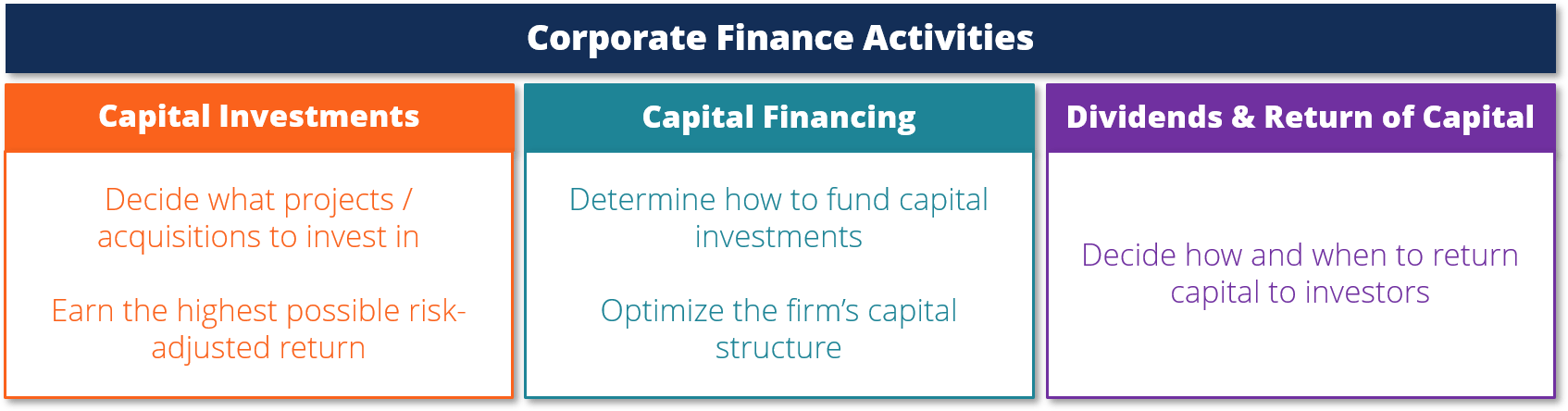
Investing and capital budgeting involve planning where to allocate the company’s long-term capital assets to generate the highest risk-adjusted returns. They primarily involve deciding whether to pursue an investment opportunity and are carried out through extensive financial analysis.
By using financial accounting tools, a company identifies capital expenditures, estimates cash flows from proposed capital projects, compares planned investments with projected income, and decides which projects to include in the capital budget.
Financial modeling is used to estimate the economic impact of an investment opportunity and compare alternative projects. An analyst will often use the internal rate of return (IRR) in conjunction with net present value (NPV) to compare projects and pick the optimal one.
This core activity includes decisions on how to optimally finance the capital investments (discussed above) through the business’s equity, debt, or a mix of both. Long-term funding for major capital expenditures or investments may be obtained from selling company stocks or issuing debt securities in the market through investment banks.
Balancing the two sources of funding (equity and debt) should be closely managed because having too much debt may increase the risk of default in repayment, while depending too heavily on equity may dilute earnings and value for original investors.
Ultimately, it’s the job of corporate finance professionals to optimize the company’s capital structure by minimizing its weighted average cost of capital (WACC).
This activity requires corporate managers to decide whether to retain a business’s excess earnings for future investments and operational needs or to distribute them to shareholders as dividends or share buybacks.
Retained earnings that are not distributed back to shareholders may be used to fund a business’s expansion. This can often be the best source of funds, as it does not incur additional debts nor dilute the value of equity by issuing more shares.
At the end of the day, if corporate managers believe they can earn a rate of return on a capital investment that exceeds the company’s cost of capital, they should pursue it. Otherwise, they should return excess capital to shareholders via dividends or share buybacks.
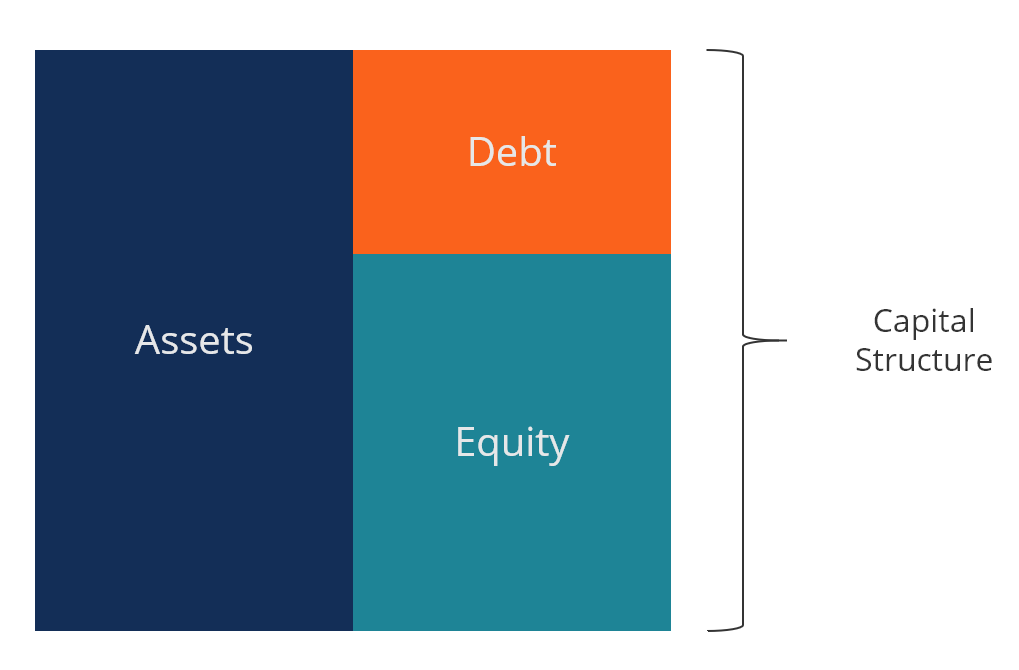
A company’s capital structure is crucial to maximizing the value of the business. Its structure can be a combination of long-term and short-term debt and/or common and preferred equity. The ratio of a firm’s liabilities to its equity is often used to determine how well-balanced or risky the company’s capital structure is.
A company that is heavily funded by debt is considered to have a more aggressive capital structure and, therefore, potentially holds more risk for stakeholders. However, taking this risk is often the primary reason for a company’s growth and success.
Connect what you just learned to a clear career path with CFI’s role‑based courses and certification programs.