Get Specialized with our (ESG) Environmental Social Governance Bundle
Sustainability
The ability to provide for the needs of the current generation using available resources without adversely affecting future generations
Over 2.8 million + professionals use CFI to learn accounting, financial analysis, modeling and more. Unlock the essentials of corporate finance with our free resources and get an exclusive sneak peek at the first module of each course.
What is Sustainability?
Sustainability is essentially the ability to meet the needs of the current generation using available resources without compromising the ability of future generations to meet their own needs. The concept doesn’t only apply to the environment, which is considered the most pressing pillar of sustainability today, but also to other aspects, including the people and the economy. This is a crucial aspect of PEST Analysis and ESG analysis.
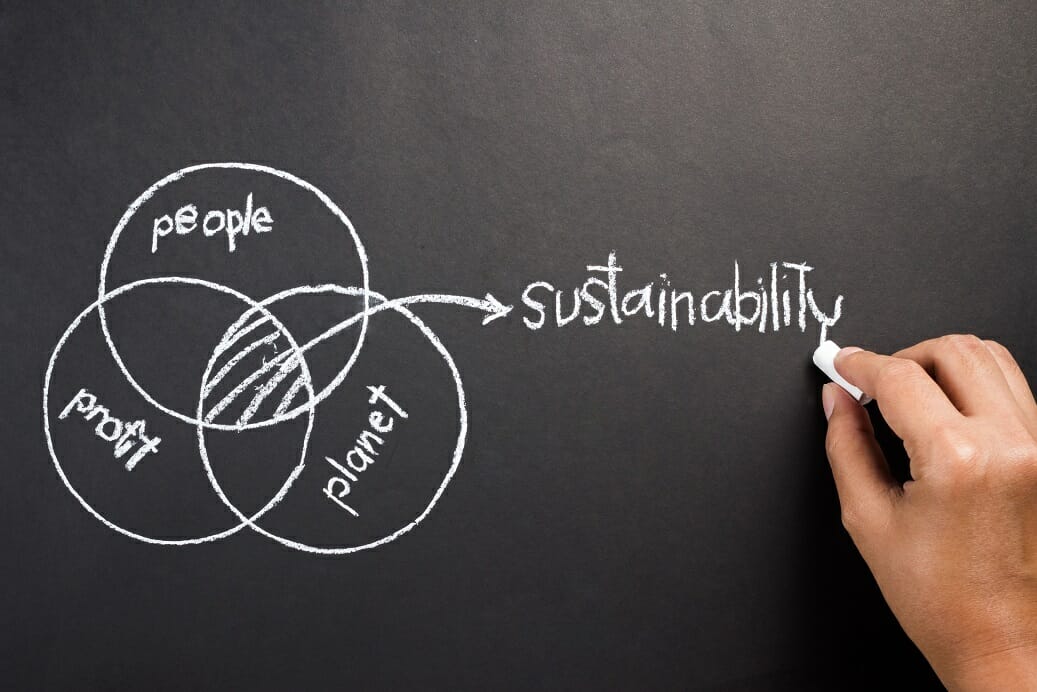
The Three Pillars of Sustainability
The three pillars of sustainability are planet or environment, social or people, and profit or economics.
1. Planet
Let us first discuss the first pillar, which is the planet, and use agriculture as an example. Imagine a piece of land that has been farmed for palm oil for decades. Ideally, farmers should take breaks between harvests, as the land’s quality will be compromised if it is overused. If overused, it will take several years for the land to recover, meaning future generations will be unable to use it for a while.
2. People
People sustainability, on another note, includes giving priority to the welfare of a company’s workforce. Let’s say, for example, Target gives bi-annual skills training to its workers that they can use in the future. The skills they acquire can be useful for Target’s operations in the future.
Additionally, it may involve providing workers with more flexible working hours and a more conducive work environment. Doing so makes the workforce happier, which will eventually lead to a more productive company.
3. Profit
As for the economy, which is often referred to as profit, sustainability means using a particular set of resources in a responsible manner that allows them to be used on a long-term basis. Furthermore, it means making money and growing the company without negatively impacting the other two pillars, people and planet, or environment.
For example, a diesel power plant operates 24 hours a day in a city using diesel engines that emit black smoke and produce a very distracting sound. Although it generates profits due to its non-stop operations, the smoke it emits surely pollutes the air, while the noise can cause long-term health disorders to the residents. Sustainability should mean balancing profit and its impact on the environment.
The great thing about sustainability is that if the people and the planet are taken care of, profits will also be achieved.
Five Domains of Sustainability
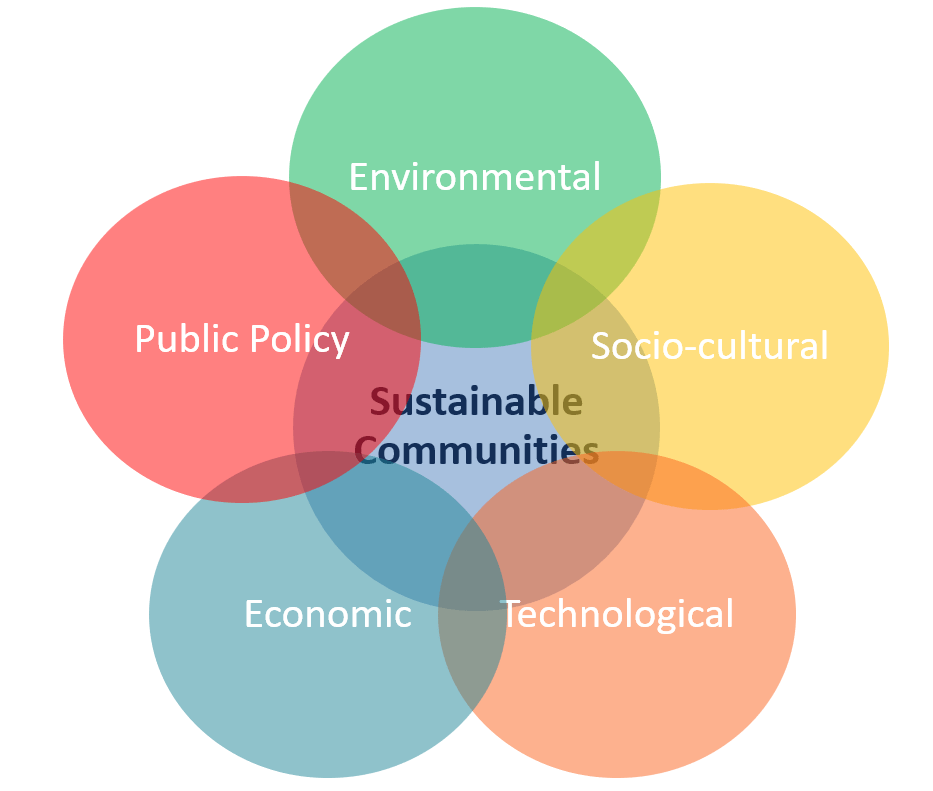
The diagram above illustrates how sustainable communities are achieved, involving the overlapping of different domains, including the three pillars of sustainability: planet (environmental), people (socio-cultural), and profit (economic). If one is missing, then a sustainable community will not be achieved.
For example, a community already has a contented set of residents because they have almost everything they need within reach, such as work opportunities, parks, and groceries; however, it lacks stable communication lines for internet connection, landline, and cellular phone access. The technological domain here is missing. Therefore, the community is not sustainable because, without communication lines, there will be no interaction or opportunity for growth and collaboration with other communities.
In another example, consider the same community with numerous job opportunities from booming companies, satisfied residents, and an impressive transportation system. However, the community lacks a public policy that will protect its residents from one of the booming companies that do not follow acceptable standards of waste disposal. Eventually, the community will be destroyed, and its resources will be depleted.
Therefore, no community can be sustainable if one of the domains is missing.
Sustainability Challenges in Finance and Investments
The relationship between profit and the other pillars of sustainability is clear and very easy to understand. However, it can be challenging for many companies or businesses because it may mean not operating at full speed to maximize profits due to the environmental and social consequences. What organizations should do is adjust their profit targets and invest in programs that will promote sustainability.
Going back to the example above about the diesel power plant that doesn’t adhere to acceptable standards of waste disposal, the company can invest in conducting research on how it can minimize its waste. They should understand that adhering to sustainability can lead to better earnings on a long-term basis and that the earnings in the next few years and decades are just as important as the earnings in the next quarter.
Additional Resources
CFI offers the Financial Modeling & Valuation Analyst (FMVA)™ certification program for those looking to take their careers to the next level. To keep learning and advancing your career, the following CFI resources will be helpful:


0 search results for ‘’
People also search for:
excel
power bi
esg
accounting
balance sheet
fmva
real estate
Explore Our Certifications
Resources
Popular Courses






Recent Searches