Get Certified for
Capital Markets (CMSA®)
From equities and fixed income to derivatives, the CMSA certification bridges the gap from where you are now to where you want to be — a world-class capital markets analyst.
A bond ETF is an exchange-traded fund that holds a diversified basket of bonds. These funds give investors access to fixed income markets through a single security traded throughout the day. Bond ETFs offer diversification by pooling thousands of securities into one investment and typically distribute income from their underlying bonds to investors as dividends.

Bond ETFs combine a bond portfolio with stock-like trading. When you buy a bond ETF, you purchase a share that represents proportional ownership in a pool of bonds. You trade this share on an exchange during market hours, and its price moves with supply and demand while the underlying bonds generate income and influence long-term returns.
Bond ETFs also calculate a net asset value (NAV), which represents the estimated value of the underlying bond portfolio. NAV is typically updated once each trading day and serves as a reference point for comparing the ETF’s market price to the value of its holdings. But share price and NAV are not the same, meaning a bond ETF may trade at prices that are higher or lower than its NAV.
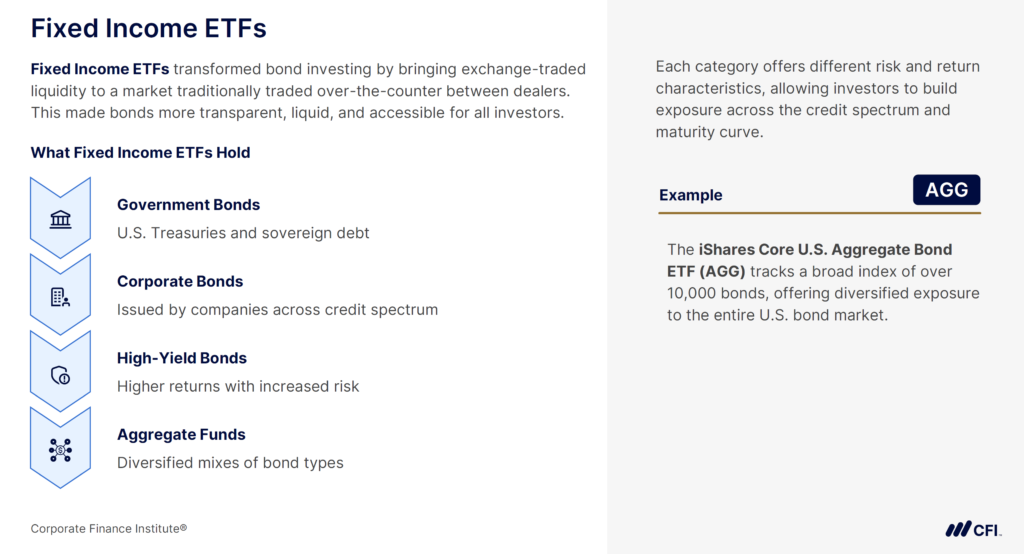
Bond ETFs follow indices that represent different parts of the fixed income market. Each category focuses on specific bond characteristics such as credit quality, maturity, and yield. The main types include:
Government bond ETFs hold sovereign debt, most commonly US Treasuries. These funds invest across short-, medium-, and long-term maturities. They typically carry lower credit risk because they are backed by the government, and their prices react mainly to changes in interest rates.
These funds invest in bonds issued by companies with strong credit ratings. They offer higher yields than government bonds while maintaining relatively low default risk. Investment-grade corporate bond ETFs appeal to investors who want stable income with moderate sensitivity to economic conditions.
High-yield bond ETFs invest in bonds from companies with lower credit ratings. The higher yields compensate investors for taking on more credit risk. These funds often experience greater price volatility, particularly during periods of economic stress when default risk increases.
Aggregate bond ETFs provide broad exposure by combining multiple bond sectors in a single fund. Portfolios usually contain government securities, corporate bonds, and mortgage-backed securities. These funds serve as core fixed income holdings because they spread risk across the investment-grade bond market.
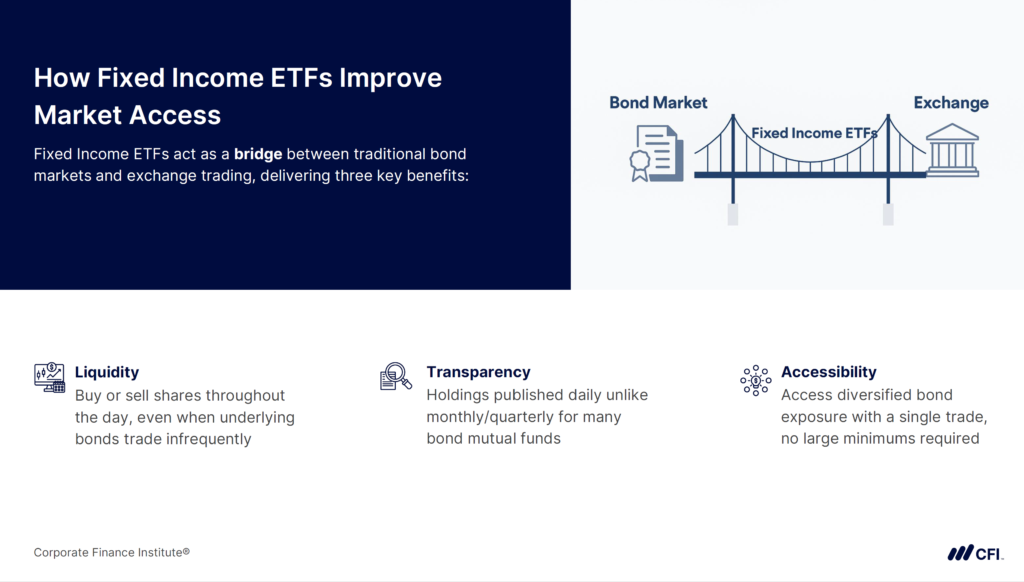
Bond ETFs address several challenges found in traditional bond investing and offer practical advantages for a wide range of investors. Three benefits stand out.
Investors can trade bond ETF shares throughout the day, even when the underlying bonds trade infrequently. Exchange trading gives investors consistent access to current pricing without the delays of dealer-negotiated transactions. This structure reduces friction and makes it easier to adjust fixed income positions quickly.
Many bond ETFs publish their holdings daily, which gives investors clear insight into the portfolio. Some bond mutual funds disclose holdings less frequently. Daily reporting helps investors track changes and understand the fund’s composition with greater accuracy.
Bond ETFs make diversified fixed income exposure available through single share purchases. Traditional bond investing often requires significant capital to buy individual bonds or build diversified portfolios. ETFs lower these barriers by packaging many bonds into affordable, exchange-traded shares that are easy to buy and sell.
Bond ETFs offer a practical and scalable way for investors to access fixed income markets, whether they are building retirement portfolios or managing larger allocations.
Bond ETFs involve challenges and trade-offs that reflect how bonds trade and how their prices are updated in the market.
Many individual bonds trade infrequently, which can create price gaps between ETF shares and the estimated value of the underlying portfolio. ETF prices adjust continuously on exchanges, while bond valuations often rely on older dealer quotes. As a result, the market price of a bond ETF may diverge from its estimated value more often than equity ETFs.
Bond ETFs can have wider bid-ask spreads than equity ETFs, especially in segments where the underlying bonds trade less often. Dealer intermediation and limited trading activity in the bond market increase transaction costs. These higher spreads make it more expensive for investors to buy or sell shares of ETFs that hold less liquid bonds.
Bond ETFs may experience tracking differences because many bond indices hold thousands of securities, some of which rarely trade or are difficult to source. Managers often use sampling techniques instead of holding every bond in the index. This can result in small performance differences relative to the index, a challenge that appears less frequently in equity ETFs with more actively traded constituents.
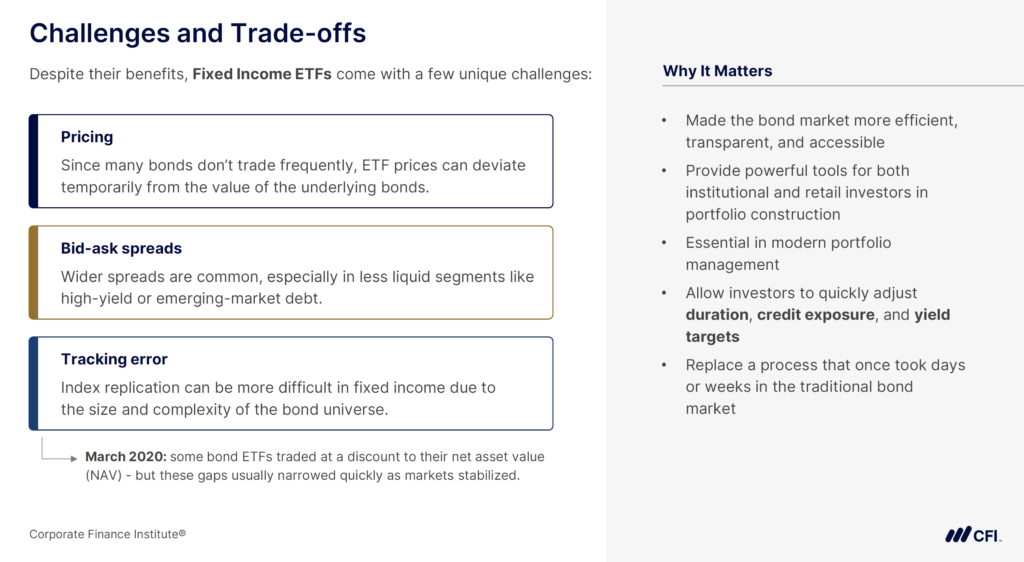
The market stress of March 2020 showed how bond ETF prices respond during periods of severe volatility. Many bond ETFs traded at discounts to their net asset value (NAV), creating clear gaps between market prices and the reported value of the underlying bonds.
Bond ETF prices declined more quickly than their calculated NAVs. Some funds traded at discounts of several percentage points to the estimated value of their portfolios. This pattern appeared across many categories and became most visible in corporate bond and high-yield ETFs.
The gap reflected differences in how ETF prices and individual bond prices are updated. ETFs traded continuously on exchanges, so their prices adjusted in real time. Many individual bonds did not trade, and dealers were not providing fresh quotes. As a result, the bond valuations used for NAVs lagged behind the fast-moving ETF market.
The episode showed that ETF prices can provide timely price signals during periods of market stress. ETF trading captured shifting liquidity conditions and investor sentiment, while many individual bond prices changed more slowly. This highlighted how ETFs contribute to transparency in fixed income markets when trading activity in underlying bonds is limited.
No, bond ETFs are pooled investments that invest in a range of bonds and trade on exchanges like a stock. Individual bonds trade through dealers and have fixed maturity dates with defined cash flows. Bond ETFs provide diversification and intraday liquidity, while single bonds offer scheduled principal repayment.
Yes, most bond ETFs pay dividends. The bonds held in the ETF pay regular interest (coupon payments). The ETF collects that interest and then passes it on to investors as dividends. These dividends are usually paid monthly, though some ETFs distribute quarterly.
Bond ETFs face market risk from interest rate changes and credit deterioration. Pricing gaps occur because ETF prices update in real-time while underlying bonds use stale dealer quotes. Bond ETFs often have wider bid-ask spreads than equity ETFs, especially in less liquid segments.
A bond ETF holds fixed income securities and provides returns through price changes and dividend distributions funded by bond interest. A stock ETF holds shares of publicly traded companies and reflects changes in earnings and equity market conditions. Bond ETFs often show lower volatility than broad stock ETFs, depending on the bonds they hold.
From equities and fixed income to derivatives, CFI’s CMSA program bridges the gap from where you are now to where you want to be — a world-class capital markets analyst.